Have you ever noticed that you can balance comfortably on one leg but wobble almost immediately on the other? Perhaps one shoulder feels tighter, one hip moves more freely, or an exercise feels completely different when you change sides.
You are certainly not the only person to notice these differences.
Our bodies are not perfectly symmetrical. We develop preferences, habits, and movement patterns throughout our lives. We may consistently carry a bag on the same shoulder, lead with the same leg, sit in a familiar position, participate in sports that favour one side, or simply rely more heavily on our dominant hand or foot. Over time, one side may feel stronger, more mobile, more stable, or simply easier to coordinate than the other.
Pilates has an interesting way of bringing these differences to our attention.
This does not necessarily mean something is wrong. Instead, becoming aware of how your body moves can provide useful information and create an opportunity to develop greater control, coordination, strength, and confidence.
Why Does One Side of the Body Feel Stronger Than the Other?
There is rarely one simple explanation.
The human body is naturally asymmetrical to some degree. Daily habits, previous injuries, repetitive activities, occupation, sports, mobility, strength, balance, and individual anatomy can all influence how one side of the body feels compared with the other. You may also have developed movement patterns without realizing it.
Consider how many times you repeat familiar movements during an ordinary day. You may always step forward with the same foot, carry a child on the same hip, cross the same leg while sitting, reach with your dominant hand, or shift your weight onto the same side while standing.
The body becomes very good at doing what it repeatedly practices.
Importantly, a side that feels stronger is not necessarily a side that is functioning “better.” Strength is only one element of movement. Stability, mobility, coordination, control, and confidence can also differ from one side to the other.
This is one reason paying attention to how you move can be more informative than simply asking which side is stronger.
Why Do These Differences Become So Noticeable During Pilates?
Pilates asks you to pay attention.
Instead of simply completing a movement, you are encouraged to consider how you are completing it.
- Where is your weight?
- Is your pelvis shifting?
- Are your shoulders remaining organized?
- Does one leg feel steadier than the other?
- Can you control the movement equally well in both directions?
- Are you holding unnecessary tension somewhere else in the body?
The principles of Pilates emphasize concentration, control, precision, breath, and awareness. When movement becomes more deliberate, differences that were easy to overlook during everyday activities may suddenly become much easier to recognize.
In other words, Pilates may not have created the difference you are noticing. The practice may simply have given you an opportunity to become aware of it.
The Body Is Very Good at Finding Another Way
One of the remarkable things about the human body is its ability to adapt.
When a movement needs to happen, the body will often find a way to accomplish it. If one area is less mobile, stable, coordinated, or comfortable, another area may contribute more to complete the task.
This adaptability is useful. It allows us to continue moving through an enormous variety of circumstances.
It can also make certain movement habits difficult to recognize.
If your goal is simply to complete an exercise, you may never notice that you consistently shift your weight, rotate slightly, rely more heavily on one side, or create tension somewhere else to make the movement possible.
Pilates changes the question. Rather than asking only, “Can I do this exercise?” the practice encourages you to ask, “How am I doing this exercise?” That distinction is an important part of developing body awareness.
What Can the Reformer Tell You About Your Movement?
The Reformer can provide valuable physical feedback because the carriage, springs, straps, and footbar respond directly to the forces you create.
You may discover that one leg presses more confidently than the other, one arm has greater control, or one direction feels noticeably different. The movement of the carriage can make subtle differences easier to recognize because you are working with resistance while also controlling a moving surface.
However, the Reformer is only one part of the picture. Within Classical Pilates, changing the apparatus changes the demands placed on the body. This gives both the practitioner and instructor an opportunity to observe movement from several perspectives.
Why Classical Pilates Uses More Than One Apparatus
At Just Breathe Pilates, we teach Classical Pilates as a comprehensive system rather than focusing exclusively on the Reformer.
Mat work and traditional apparatus, including the Reformer, Tower, Chair, and other equipment, challenge and support the body in different ways.
A movement difference that is subtle on the Reformer may become more noticeable on the Mat. Something that feels difficult without assistance may become easier to understand with the support of springs on the Tower. The Chair may introduce a different challenge to balance, stability, strength, or control.
The purpose is not to search constantly for something that is “wrong.” Instead, working across the Classical Pilates system gives you opportunities to experience movement in different contexts. The apparatus changes, but the body remains yours. Each experience can teach you something about how you move.
Is Perfect Symmetry the Goal?
No.
The goal of Pilates is not to force every body into perfect symmetry. Human beings are not perfectly symmetrical, and differences between the two sides of the body are not automatically a problem. What matters is developing greater awareness of your movement and learning how to move with control and confidence.
For example, noticing that one side feels less stable does not mean you should immediately perform twice as many exercises on that side. The reason for the difference may not be obvious, and simply adding more repetitions does not necessarily address what is happening.
Instead, thoughtful Pilates instruction considers the quality of the movement. Can you perform the exercise with control? Are you compensating somewhere else? Would changing the resistance, position, range of motion, or apparatus help you understand the movement differently? The objective is not perfection. It is awareness and improved movement quality.
Why Small Pilates Classes Matter
There are aspects of your movement that can be difficult to observe yourself.
You may feel as though you are perfectly centred while your weight has shifted slightly to one side. You may not notice that one shoulder consistently rises, that your pelvis rotates during a particular movement, or that you rely more heavily on one leg.
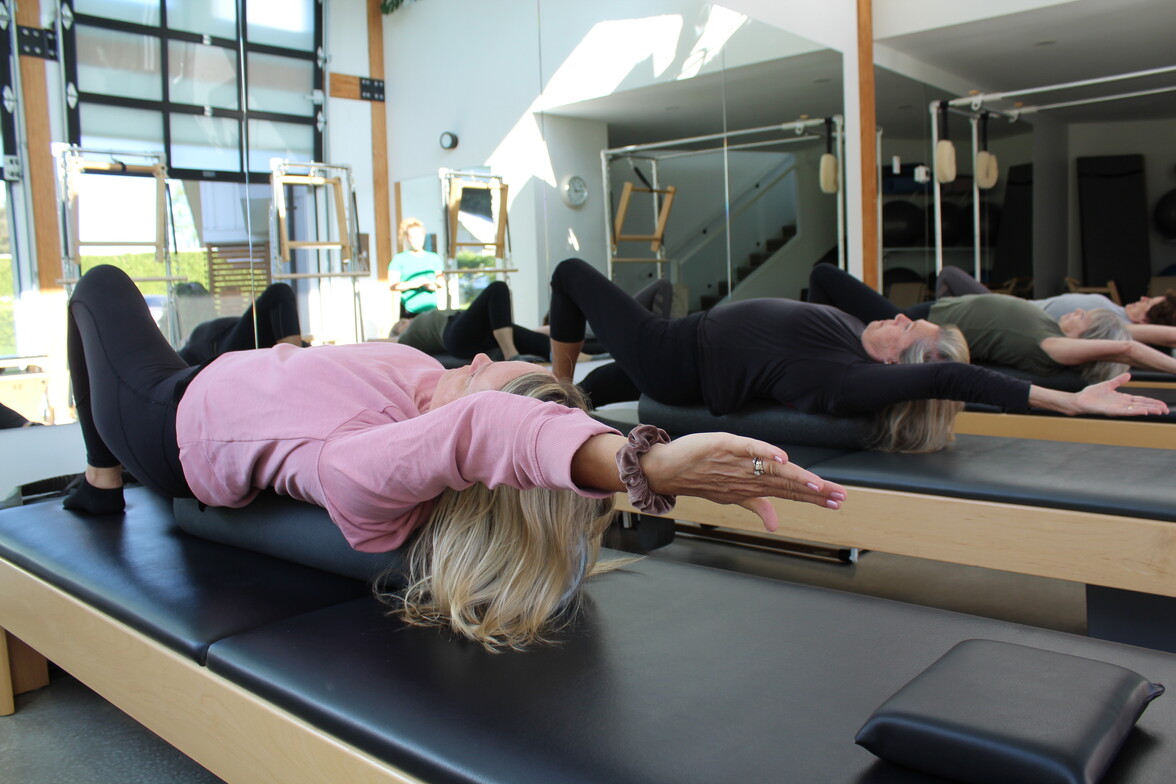
This is where thoughtful instruction becomes especially valuable. At Just Breathe Pilates in Abbotsford, our small class sizes allow instructors to observe each participant rather than simply direct the room as a whole. An instructor can watch how you approach an exercise, provide feedback, suggest an appropriate adjustment, and help you understand what you are experiencing.
Sometimes a small correction can completely change how an exercise feels. This individual attention is one of the reasons we intentionally keep our classes small. Pilates is not meant to feel anonymous. Understanding the person performing the movement matters.
What About Private Pilates?
For clients who want greater individualized attention, private Pilates sessions provide an opportunity to explore movement one-on-one with an instructor.
This can be particularly useful for beginners learning the foundations of Pilates, clients with specific movement goals, or anyone who simply learns more comfortably in an individual environment. A private session gives the instructor more time to observe how you move across different exercises and apparatus and to adapt the session accordingly.
Just Breathe Pilates offers both private instruction and small group classes, allowing clients to choose the environment that best supports their experience and goals.
What Should You Notice During Your Next Pilates Class?
The next time you practise Pilates, resist the temptation to immediately label one side as “good” and the other as “bad.”
Instead, become curious.
- Does one side feel easier to coordinate?
- Is your balance different?
- Does one hip have a different range of movement?
- Does one shoulder feel more comfortable?
- Can you control the carriage equally in both directions?
- Does your breathing change when an exercise becomes more challenging?
These observations are information.
One of the most valuable skills Pilates can develop is the ability to notice what your body is doing without immediately judging it. Greater awareness creates an opportunity for more intentional movement.
When Should a Difference Be Assessed?
A difference between sides does not automatically indicate an injury or medical problem. Some degree of asymmetry is normal.
However, a new or significant change—particularly one accompanied by pain, numbness, pronounced weakness, loss of function, or other concerning symptoms—deserves appropriate medical assessment rather than an assumption that exercise alone will resolve it. Pilates instructors can observe movement and adapt exercise within their professional scope, but Pilates is not a substitute for medical diagnosis or treatment when one is required. Understanding that distinction is part of responsible movement practice.
Discover What Your Movement Can Teach You
Pilates has a way of changing how you experience your body.
You may begin because you want to become stronger, improve your flexibility, work on your posture, or simply find a form of movement you enjoy. Along the way, you may discover something equally valuable: a greater understanding of how you move.
At Just Breathe Pilates in Abbotsford, BC, we teach Classical Pilates through Mat work and traditional Pilates apparatus, including the Reformer, Tower, Chair, and other equipment. Our small classes and private Pilates sessions allow instructors to provide thoughtful guidance while helping clients develop strength, mobility, coordination, control, and body awareness.
Your two sides may never feel exactly the same. They do not necessarily need to. The opportunity is to become more aware of the differences, understand your movement more clearly, and develop a body that is better able to move with strength, control, and confidence.
If you are interested in experiencing Classical Pilates in Abbotsford, contact Just Breathe Pilates to learn more about private instruction, beginner options, and small group classes.
Karen Voogt
Contact Me