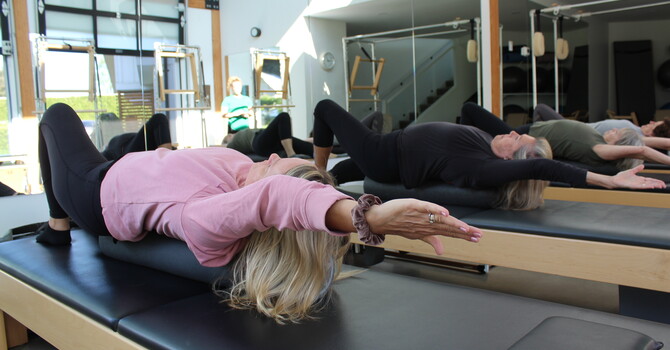
When most people think about Pilates, the Reformer is usually the first piece of equipment that comes to mind. With its moving carriage, springs, straps, and distinctive design, it has become one of the most recognizable features of Pilates studios around the world. But what many people don't realize is that the Reformer is only one part of a much larger and carefully developed system of movement.
Classical Pilates is a comprehensive method created by Joseph Pilates, who originally called his approach Contrology. His method was designed to develop strength, flexibility, coordination, balance, and control through a structured series of exercises. Rather than focusing on isolated muscle groups or simply completing a workout, Classical Pilates encourages the body to move as a coordinated whole. Each exercise has a purpose, and the various pieces of equipment were developed to support different aspects of that work.
At Just Breathe Pilates, we believe there is tremendous value in understanding the method behind the movements. When you begin to recognize why certain exercises are performed, how the equipment supports them, and how the movements connect, Pilates becomes much more than a fitness class. It becomes an opportunity to develop a deeper understanding of your body and how it moves.
Our studio uses a variety of equipment, including the Reformer, Tower, Pilates Chairs, Spine Corrector, and Mat, with a traditional Cadillac available primarily for private sessions. Each apparatus offers a different way to explore movement, creating opportunities for both foundational learning and continued progression.
Whether you are completely new to Pilates or have been practising for years, understanding the equipment offers a fascinating look at the depth and versatility of the Classical Pilates method.
The Reformer: More Than a Moving Carriage
The Reformer is perhaps the most familiar piece of Classical Pilates equipment, and its popularity is easy to understand. Its design allows for an extraordinary variety of exercises that challenge the body in different ways. A padded carriage moves along a frame, connected to springs that create varying levels of resistance. A footbar, straps, and adjustable components allow exercises to be performed while lying down, sitting, kneeling, or standing.
What makes the Reformer particularly interesting is how it changes the experience of movement. Unlike many traditional gym machines that are designed to isolate individual muscle groups, the Reformer encourages coordinated movement throughout the body. Even when an exercise appears to focus on the arms or legs, other areas of the body are often working to provide stability, maintain alignment, and control the movement of the carriage.
One of the most misunderstood features of the Reformer is its spring system. It might seem logical to assume that adding more springs makes an exercise harder, while removing springs makes it easier. However, the relationship between spring tension and difficulty is much more complex. Depending on the exercise, the springs can provide resistance that challenges muscular strength or assistance that helps support the body through a particular movement. In some exercises, reducing spring tension actually increases the demand for stability and control.
This versatility is part of what makes the Reformer such a valuable component of Classical Pilates. The equipment can be used to introduce foundational movement patterns, refine familiar exercises, and create increasingly challenging sequences as a person's practice develops.
The Classical Reformer repertoire includes a wide variety of exercises, each offering a different experience of strength, coordination, and control. The Rowing Series, for example, involves coordinated arm movements using the straps while the rest of the body works to maintain stability and support the movement. Although the arms are visibly active, the exercises require much more than upper-body strength. They demonstrate how the Classical Pilates method connects movement throughout the body rather than treating individual areas separately.
Another recognizable exercise is the Teaser, which can be performed in several variations, including Teaser on the Box. This movement challenges abdominal strength, balance, spinal control, and coordination. While the final position may appear impressive, the real work lies in how the body moves into and out of that position. Maintaining control throughout the sequence is just as important as achieving the shape of the exercise itself.
Long Stretch introduces a different kind of challenge. Resembling a plank performed on a moving carriage, it requires the body to maintain a strong, connected position while the carriage travels away from and toward the footbar. The movement places demands on shoulder stability, abdominal strength, and full-body coordination. Rather than relying on speed or momentum, the exercise emphasizes maintaining the quality of the position throughout the movement.
Mermaid offers yet another experience of the Reformer. Instead of focusing primarily on strength or stability, this exercise explores lateral movement through the spine. The controlled side-bending motion encourages mobility, coordination, and awareness of how the torso moves in different directions. Its flowing appearance provides a beautiful contrast to more strength-focused exercises, demonstrating the variety that exists within the Classical Pilates repertoire.
Together, these movements illustrate why the Reformer is much more than a machine for performing exercises. It is a versatile apparatus that supports a connected method of movement, offering opportunities to develop strength, mobility, coordination, and control throughout an ongoing Pilates practice.
The Tower: Versatility, Support, and Controlled Movement
The Tower is an important part of the Classical Pilates equipment system, offering a wide range of exercises that develop strength, flexibility, coordination, and control. While it shares many similarities with the traditional Cadillac, the Tower has a more compact design, making it particularly well suited to a studio environment.
The Tower features a stable, padded surface with an upright frame that supports springs, bars, and other attachments. Unlike the Reformer, which uses a moving carriage, the Tower allows the body to work against or with the assistance of springs while remaining on a stationary surface. This creates opportunities to explore movement in different positions, including lying down, sitting, kneeling, and standing.
One of the most interesting features of the Tower is its versatility. Depending on the exercise, the springs can provide resistance to develop strength or assistance to support controlled movement. Some exercises emphasize spinal mobility and flexibility, while others challenge coordination, stability, and muscular endurance.
The Tower shares much of its exercise repertoire with the Cadillac, another traditional piece of Classical Pilates equipment. The primary distinction is that the Cadillac includes a full overhead frame that accommodates additional exercises, including certain inversions and suspended movements. The Tower offers many of the same foundational movement opportunities without that overhead structure.
At Just Breathe Pilates, the Tower is an important part of our equipment-based practice, allowing clients to experience a variety of movements within the Classical Pilates method. We also have a traditional Cadillac, which is used primarily during private sessions, where its additional features can be incorporated into individualized instruction.
Both pieces of equipment demonstrate how Classical Pilates uses support and resistance intentionally, providing different ways to develop strength, mobility, coordination, and control.
Pilates Chairs: Small Equipment With Significant Challenges
Pilates Chairs are among the most versatile pieces of equipment within the Classical Pilates system. Although compact in size, they offer an extensive repertoire of exercises that can challenge strength, balance, coordination, and control in ways that are quite different from the Reformer or Tower.
A Pilates Chair typically consists of a sturdy frame with a spring-loaded pedal that moves against resistance. Depending on the exercise, movements may be performed while sitting, standing, kneeling, or supporting the body's weight through the arms. The springs can provide resistance or assistance, creating different levels of challenge throughout the repertoire.
What makes the Pilates Chair particularly interesting is how much work can happen within such a small piece of equipment. Many exercises require the body to maintain stability while moving against spring resistance, often from a relatively small base of support. This creates opportunities to develop strength, coordination, balance, and precise movement control.
At Just Breathe Pilates, we use Balanced Body CentreLine and EXO Chairs, which provide opportunities to explore the Classical Pilates Chair repertoire. These pieces of equipment allow clients to experience a variety of exercises while developing the strength and coordination needed for increasingly challenging movements.
The Pilates Chair is a wonderful reminder that effective movement doesn't require large equipment or complicated exercise sequences. Sometimes the simplest-looking movements demand the greatest concentration and control.
Like the other apparatus within Classical Pilates, the Chair is not intended to function as an isolated workout machine. It is part of a connected system, offering different ways to explore familiar movement principles and continue developing a well-rounded Pilates practice.
The Spine Corrector: Exploring Movement Through the Spine
The Spine Corrector is a traditional piece of Pilates equipment that uses a curved surface to support different exercises. Its distinctive shape features a rounded section and a step-like platform, allowing the body to be positioned in ways that create different opportunities for movement.
Unlike the Reformer, Tower, or Pilates Chairs, the Spine Corrector does not use springs to create resistance. Instead, the shape of the apparatus and the relationship between the body and gravity provide the challenge. The curved surface supports exercises that explore spinal extension, lateral movement, abdominal strength, and coordination.
Despite its name, the Spine Corrector should not be understood as a device that automatically corrects posture or treats spinal conditions. Rather, it provides a particular surface from which controlled exercises can be performed.
Some exercises emphasize mobility and flexibility, while others challenge the abdominal muscles and require significant control. The apparatus allows familiar movement patterns to be experienced differently by changing how the body is supported.
The Spine Corrector demonstrates another important aspect of Classical Pilates: equipment does not always need moving parts or adjustable resistance to create meaningful movement challenges. Sometimes the position of the body and the shape of the equipment are enough to introduce an entirely different experience.
The Mat: The Foundation of Classical Pilates
With so much attention given to specialized equipment, it can be easy to overlook one of the most important components of Classical Pilates: the Mat.
Mat Pilates uses the body's own weight and gravity to create resistance and challenge. Without springs, straps, or a moving carriage to provide assistance, the individual must organize and control their movements through their own strength and coordination.
The traditional Classical Mat repertoire includes exercises such as The Hundred, Roll Up, Single Leg Stretch, Spine Stretch Forward, and Teaser. These movements share principles with exercises performed on the apparatus, connecting the Mat to the broader Classical Pilates system.
A common misconception is that Mat Pilates is simply an easier or more basic version of Reformer Pilates. In reality, the two offer different challenges. The Reformer can provide assistance through its spring system, while Mat exercises often require the body to perform movements without that external support.
This does not mean that one is automatically more difficult than the other. The demands of an exercise depend on the movement itself, the individual's experience, and how the exercise is performed.
Both Mat and apparatus work have important roles within Classical Pilates. Together, they provide opportunities to develop strength, coordination, flexibility, and control through a connected system of exercises.
How the Classical Pilates Equipment Works Together
One of the defining characteristics of Classical Pilates is that the various pieces of equipment are not intended to function as completely separate workout experiences. Instead, they belong to a larger system in which exercises and movement principles connect across different apparatus.
A movement that feels challenging on the Mat may become more accessible when assistance is provided through springs on another piece of equipment. An exercise that feels familiar on the Reformer may introduce an entirely different challenge when performed on a Pilates Chair. A movement designed to explore spinal mobility may be experienced differently on the Spine Corrector than it would be on the Tower.
These relationships create opportunities for progression and continued learning. Rather than constantly introducing new exercises simply for the sake of variety, Classical Pilates encourages individuals to revisit familiar movements, refine their technique, and gradually develop the strength and coordination required for more challenging work.
This is part of what makes the method so enduring. The exercises are structured, but there is considerable depth within that structure. A movement someone has performed many times can continue to offer opportunities for improvement as their understanding and physical abilities develop.
The equipment provides different ways to explore the same underlying principles, helping create a practice that can evolve over time.
Why Knowledgeable Instruction Makes a Difference
For someone unfamiliar with Classical Pilates, the equipment can initially appear complicated or even intimidating. Moving carriages, adjustable springs, straps, bars, and unfamiliar exercise positions may leave a new client wondering where to begin.
This is where knowledgeable instruction becomes especially important.
A Classical Pilates instructor understands not only how individual exercises are performed, but also how those exercises relate to the broader system. They can observe how a person approaches movement, provide appropriate guidance, and select exercises that suit their experience and abilities.
Thoughtful instruction also helps clients understand the purpose behind the exercises. Rather than simply following a sequence of movements, clients have opportunities to learn why certain positions matter, how different exercises connect, and what they are working toward as their practice develops.
At Just Breathe Pilates, our small classes allow for individual attention and an approach to instruction that recognizes each client's experience. We understand that everyone arrives with different strengths, movement histories, and goals, and that meaningful progress does not look identical for every person.
Some clients are learning the fundamentals for the first time, while others are refining exercises they have practised for years. Both experiences have value, and both offer opportunities to continue developing within the Classical Pilates method.
Do You Need to Be Strong or Flexible to Begin Classical Pilates?
One of the most common misconceptions about Pilates is that you need to arrive with a certain level of strength, flexibility, or coordination before you can participate.
In reality, these are among the qualities that people often hope to develop through their practice.
You do not need to understand the equipment, recognize the names of the exercises, or be capable of performing advanced movements before beginning. Classical Pilates is a progressive method, and the fundamentals provide an important foundation for the exercises that follow.
With appropriate instruction, individuals can begin developing their understanding of movement while gradually building strength, flexibility, coordination, and control.
Progress does not always mean moving to a more advanced exercise or increasing resistance. Sometimes progress involves performing a familiar movement with greater precision, developing better coordination, or gaining confidence in an exercise that once felt unfamiliar.
The value of Classical Pilates lies not only in what the body can eventually accomplish, but also in the learning and development that happen throughout the process.
Experience Classical Pilates at Just Breathe Pilates
There is much more to Classical Pilates than the Reformer exercises commonly seen on social media. Behind each movement is a carefully developed method with a rich history, a connected repertoire, and equipment designed to support different aspects of physical development.
From the versatility of the Reformer and Tower to the unique challenges of the Pilates Chairs, the movement opportunities offered by the Spine Corrector, and the foundational work of the Mat, Classical Pilates provides a remarkable range of ways to develop strength, flexibility, coordination, and control.
At Just Breathe Pilates, our equipment and instruction work together to create a thoughtful, progressive experience that supports each client's individual practice. For those seeking more individualized instruction, our private sessions also provide opportunities to explore additional apparatus, including the traditional Cadillac.
We value the depth of the Classical Pilates method and the opportunities it creates for ongoing learning. Our approach emphasizes knowledgeable instruction, purposeful movement, and a welcoming environment where clients can develop their practice with confidence.
Whether you are curious about trying Pilates for the first time or looking to deepen an established practice, there is always something new to discover.
Classical Pilates is not about performing every exercise perfectly or reaching the most advanced level as quickly as possible. It is about developing a greater understanding of movement, building physical capability, and creating a practice that continues to challenge and support you over time.
Discover what Classical Pilates can offer you at Just Breathe Pilates. Explore our classes and book your next session through Jane.
Just Breathe Pilates — Guidance. Strength. Confidence.
Karen Voogt
Contact Me