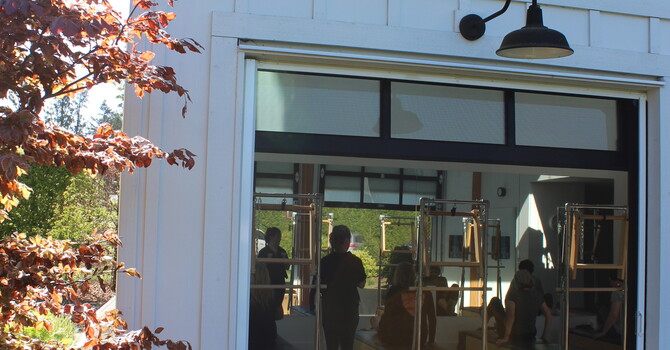
Classical Pilates vs. Reformer Pilates: Understanding the Difference
If you have recently searched for Pilates classes in Abbotsford, you have likely encountered the Reformer. With its sliding carriage, springs, straps, and distinctive frame, the Reformer has become one of the most recognizable elements of contemporary Pilates.
Its popularity, however, has also created some confusion about the distinction between Reformer Pilates and the broader Pilates method.
The Reformer is not separate from Classical Pilates; it is an important part of it. Classical Pilates is a comprehensive system that incorporates Mat work and a range of specialized apparatus, including the Reformer, Cadillac or Tower, Wunda Chair, and Barrels. Each component has a particular purpose, and together they form an integrated method of movement.
At Just Breathe Pilates in Abbotsford, this comprehensive approach is central to how we teach. Rather than focusing exclusively on one piece of equipment, we use the Classical Pilates system to help clients develop strength, mobility, coordination, posture, control, and greater awareness of how their bodies move.
Understanding this distinction can help you determine what kind of Pilates experience you are looking for.
What Is Classical Pilates?
Classical Pilates is rooted in the system of exercises developed by Joseph Pilates. The method emphasizes principles such as control, concentration, precision, breath, coordination, and purposeful movement.
Rather than approaching the body as a collection of individual muscles to be trained separately, Classical Pilates encourages the body to function as an integrated whole. Strength, mobility, stability, breathing, and coordination are developed in relationship to one another.
This philosophy extends to the equipment itself.
Classical Pilates is not defined by a single apparatus. Mat exercises and specialized equipment work together as parts of the same system. The Reformer, Tower, Chair, and other apparatus provide different forms of resistance, assistance, support, and feedback.
An exercise that presents a particular challenge on the Mat, for example, may be explored differently on the Reformer. The support of the Tower may help a client better understand a movement, while the Chair may reveal a need for greater balance, strength, or control.
The value lies not simply in having access to different pieces of equipment, but in understanding how they complement one another.
Where Does the Reformer Fit?
The Reformer is one of the foundational apparatus of the Pilates method.
Its moving carriage, springs, straps, and footbar allow resistance and assistance to be adjusted according to the exercise and the individual. This versatility makes the Reformer useful for developing strength, stability, mobility, coordination, balance, and control.
Reformer Pilates can therefore be an excellent form of movement in its own right.
The distinction arises when the Reformer becomes the primary or exclusive focus of a Pilates program.
A Reformer-focused class generally centres its exercises on that particular apparatus. Classical Pilates, by contrast, places Reformer work within a broader system that also incorporates Mat exercises and other traditional apparatus.
The difference is not a matter of deciding which approach is superior. It is a difference in scope.
Why Does Classical Pilates Use Multiple Apparatus?
Each piece of Classical Pilates equipment presents the body with a different set of demands.
Mat work requires the practitioner to create much of the necessary support and stability through the body itself. The Reformer introduces adjustable spring resistance and the challenge of controlling a moving carriage. The Tower uses springs and bars to provide resistance or assistance from different positions, while the Chair offers its own challenges for strength, balance, stability, and control.
These apparatus are not intended to function as unrelated exercise stations. They are interconnected teaching tools.
A movement learned on one apparatus may provide insight into an exercise performed on another. A weakness that becomes apparent during Mat work may be addressed with the assistance of the Reformer or Tower. Greater control developed on the Chair may, in turn, influence how a client performs elsewhere in the system.
In this way, Classical Pilates allows the practitioner to encounter the same fundamental movement principles from different perspectives.
The result is a practice that develops not only physical ability but also a more sophisticated understanding of the body.
A Whole-Body Approach to Movement
One of the defining qualities of Classical Pilates is its emphasis on integration.
Although individual exercises may place greater demands on particular areas of the body, the method does not treat movement as a series of isolated muscular actions. Instead, attention is given to how the entire body organizes itself throughout an exercise.
Core stability is important, but so are the relationships among the pelvis, spine, shoulders, limbs, and breath. The quality of a movement depends not simply on whether it can be completed, but on how efficiently and deliberately the body performs it.
For this reason, precision is more important than repetition for its own sake.
Moving faster, adding resistance, or performing more repetitions does not necessarily represent progress. In Pilates, progress may also appear as improved alignment, greater control, smoother transitions, more efficient breathing, or a deeper understanding of a familiar exercise.
This attention to detail is one of the qualities that allows Pilates to remain challenging as a practitioner becomes more experienced.
Classical Pilates and Reformer-Focused Pilates: What Is the Difference?
Both Classical Pilates and Reformer-focused Pilates can provide valuable opportunities to develop strength, mobility, stability, and body awareness. Their primary distinction lies in how the Pilates method is approached.
Reformer-focused Pilates centres predominantly on exercises performed using the Reformer. The style, pace, sequencing, and instructional approach can vary considerably among studios and instructors.
Classical Pilates places the Reformer within a comprehensive system. Mat work and additional apparatus are used alongside it, allowing the practitioner to develop and refine movement through a wider range of experiences.
For someone choosing a Pilates studio in Abbotsford, it may therefore be more useful to consider the type of experience you want rather than asking which approach is inherently better.
Are you primarily interested in exercising on the Reformer, or would you like to explore Pilates as a broader movement system?
Both are valid choices. Understanding the distinction allows you to choose intentionally.
Why Quality of Instruction Matters
Regardless of the equipment being used, thoughtful instruction remains one of the most important elements of a Pilates practice.
The apparatus can provide resistance, assistance, and valuable physical feedback, but it cannot observe how an individual is moving. An experienced instructor can recognize compensations, adjust an exercise when appropriate, clarify its purpose, and help a client develop greater awareness of movement patterns.
This is particularly important in Classical Pilates, where exercises are not taught as isolated movements. Instructors must understand how different exercises and apparatus relate to one another and how those relationships can be used to support an individual practitioner's development.
At Just Breathe Pilates, small class sizes are an intentional part of our approach. By limiting our beginner groups to a maximum of five participants, our instructors are able to maintain meaningful attention to each individual.
A smaller group provides more opportunities to ask questions, receive personalized guidance, and develop an understanding of not only what you are doing, but why you are doing it. It also allows your instructor to observe how you move and offer appropriate corrections or modifications as you learn.
For someone who is new to Pilates, this personal attention can make an important difference.
Is Classical Pilates Appropriate for Beginners?
Classical Pilates can provide an excellent foundation for someone who is completely new to the method.
Beginners are not expected to arrive with exceptional flexibility, strength, coordination, or knowledge of Pilates terminology. These qualities develop through consistent practice and appropriate instruction.
Beginning with a structured introduction allows a new client to become familiar with fundamental movement principles, breathing, alignment, and the equipment before progressing into more advanced work.
At Just Breathe Pilates, our introductory series introduces beginners to the Classical Pilates method as a whole. Rather than learning exclusively on the Reformer, participants have the opportunity to experience Mat work and traditional Classical Pilates apparatus, including the Reformer, Tower, and Chair.
Each apparatus challenges and supports the body differently. Experiencing them together helps beginners develop a broader understanding of movement, alignment, control, strength, and breath while discovering how the different elements of Classical Pilates complement one another.
New clients may also choose to begin with introductory private lessons. Private instruction provides dedicated one-on-one attention and allows the instructor to become familiar with a client's goals, questions, movement patterns, and individual considerations.
For those who enjoy learning alongside others, our small beginner series offers the opportunity to progress within a supportive group while still receiving individual attention.
We currently have space available in our new Monday Beginner Series, beginning at 12:30 p.m. With a maximum of five participants, the series is designed to provide the personal guidance and thoughtful instruction that can make beginning Pilates feel approachable and rewarding.
No previous Pilates experience is required. The purpose of the introductory series is to give you the foundation from which that experience can develop.
Pilates Is More Than a Collection of Exercises
One of the lasting benefits of Classical Pilates is that the practice evolves alongside the practitioner.
At first, much of your attention may be devoted to learning the movements and understanding the equipment. With experience, however, your awareness begins to change. You may recognize where you tend to create unnecessary tension, where one side of the body behaves differently from the other, or where greater stability or mobility is required.
Exercises that once seemed simple can become more complex as your understanding deepens.
Progress, therefore, is not measured only by performing increasingly difficult exercises. It can also be found in greater precision, efficiency, coordination, control, and awareness.
This is what transforms Pilates from a series of exercises into a practice.
Discover Classical Pilates in Abbotsford
If you have been searching for Reformer Pilates in Abbotsford, the Reformer may be an excellent introduction to the method. It is versatile, challenging, and an important part of the Pilates system.
It is also only one part of what Pilates has to offer.
At Just Breathe Pilates in Abbotsford, BC, we teach Classical Pilates through Mat work and traditional Pilates apparatus, including the Reformer, Tower, Chair, and other equipment. Our small-class environment allows us to emphasize thoughtful instruction, precise movement, and the development of each individual practitioner.
For those who are new to Pilates, our introductory series provides the opportunity to experience the broader Classical Pilates method while learning in a small, supportive environment.
There is still space available in our Monday Beginner Series at 12:30 p.m. If you have been considering Pilates but have not known where to begin, this is an opportunity to learn the foundations with personal attention and guidance from the start.
The Reformer may be what first introduces you to Pilates. Classical Pilates allows you to understand the method as a whole.
Contact Just Breathe Pilates to learn more or reserve your place in the upcoming Monday Beginner Series.
Karen Voogt
Contact Me